Maths Intent, Implementation and Impact Statement
Intent:
The intent of our teaching of Mathematics is to provide children with a foundation for understanding number, reasoning, thinking logically and problem solving with resilience so that they are fully prepared for the future. It is essential that these keystones of Mathematics are embedded throughout all strands of the National Curriculum. By adopting a mastery approach, it is also intended that all children, regardless of their starting point, will maximise their academic achievement and leave Holbeach Primary Academy with an appreciation and enthusiasm for Maths, resulting in a lifelong positive relationship with number.
- We ensure that we deliver a high quality Maths curriculum that is both challenging and enjoyable.
- We want children to make rich connections across mathematical ideas to develop fluency, mathematical reasoning and competence in solving increasingly sophisticated problems.
- We intend for our pupils to be able to apply their mathematical knowledge to a range of other subjects.
- We want them to know that maths is essential to everyday life and that our children are confident mathematicians who are not afraid to take risks.
- Fully develop independent learners with inquisitive minds who have secure mathematical foundations and an interest in self-improvement.
Implementation:
Our implementation is developed through a secure understanding of the curriculum and subject area.
Teaching and Learning, Content and Sequence:
- For maths, our long term planning follows the National Curriculum 2014. Short term planning is supported by the use of the White Rose Maths Hub materials and our school calculation policy.
- By using a variety of planning resources we believe that we provide a bespoke teaching and learning experience that is designed to interest, inform and inspire our children.
- Using prior knowledge as a starting point for all future planning and teaching, we plan lessons which are required for all pupils to make good progress.
- Lessons are engaging and follow a cycle of planning, to ensure that we can evidence progress over short and long periods of time.
- Maths lessons are designed with a concrete, pictorial and abstract (CPA) approach, providing our pupils with the scaffolding required to access the learning at all levels.
- We place a large emphasis on pupil engagement and design lessons which involve all pupils using questioning and modelling at the centre of every lesson.
- To implement our intent, we ensure that our children are investing in their learning and are making a positive contribution to their lessons.
Leadership, Assessment and Feedback:
- A variety of assessments informs the teaching and learning sequence, and children work on the objectives they are assessed as being at.
- Children who not making the required progress are identified through regular Pupil Progress meetings, then given extra support through booster sessions and support in class in order to meet our INTENT of developing pupils academically.
- Formative assessment within every lesson helps teachers to identify the children who need more support to achieve the intended outcome and who are ready for greater stretch and challenge through planned questioning or additional activities.
- In order to support teacher judgments, children are assessed using current and reliable tests in line with the national curriculum for maths.
- Analysis of any tests that the children complete is undertaken and fed into future planning.
- Summative assessments are completed termly, as well as the end of the academic year, which help influence the overall judgement reported to parents in the end of year report.
- The maths leaders have a clear role and overall responsibility for the progress of all children in maths throughout school. Working with SLT, key data is analysed and regular feedback is provided and discussed at Pupil Progress meetings to inform on progress and future actions.
Impact:
A mathematical concept or skill has been mastered when a child can show it in multiple ways, using the mathematical language to explain their ideas, and can independently apply the concept to new problems in unfamiliar situations.
- Children demonstrate quick recall of facts and procedures. This includes the recollection of the times tables and the related division facts.
- The flexibility and fluidity to move between different contexts and representations of mathematics.
- The ability to recognise relationships and make connections in mathematics.
- Children show confidence in believing that they will achieve.
- Children show a high level of pride in the presentation and understanding of their work.
Using Apparatus in Maths
To begin learning any new concept in Maths we start with concrete apparatus to manipulate, combine and support. These resources are used further up the school t support understanding and promote the independence in our young learners. They can be used by all ages to understand problems and puzzles also. They hold a vital role in mastery as they are the building blocks that children use to step up to visual and symbolic representations.
In school we utilise a range of resources including rods and cubes, counters, coins, blocks, counting animals, straws, clocks, 2D and 3D shapes. Here are some photos of our pupils supporting their own steps in learning.
Maths Skills Progression
How to support your child with Maths
At Holbeach Primary Academy, Times Tables Rockstars is embedded into the daily routine of Year 3/4 pupils to strengthen their understanding and recall of multiplication facts, as well as their ability to apply the commutative law. Each day, children engage in sessions that include songs, counting activities, and weekly paper-based tests to reinforce rapid recall and support the application of multiplication skills across other areas of Maths. Additionally, a lunchtime club is available to provide extra support.
TT Rockstars homework is assigned weekly, with pupils encouraged to access the platform at least three times per week at home. In Year 2, weekly TT Rockstars sessions focus on consolidating the 2, 5, and 10 times tables along with related division facts, preparing children for the transition into Year 3. Daily practice continues in Year 3, ensuring pupils can confidently recall and use the 3, 4, and 8 times tables, equipping them with the foundational knowledge required for Year 4.

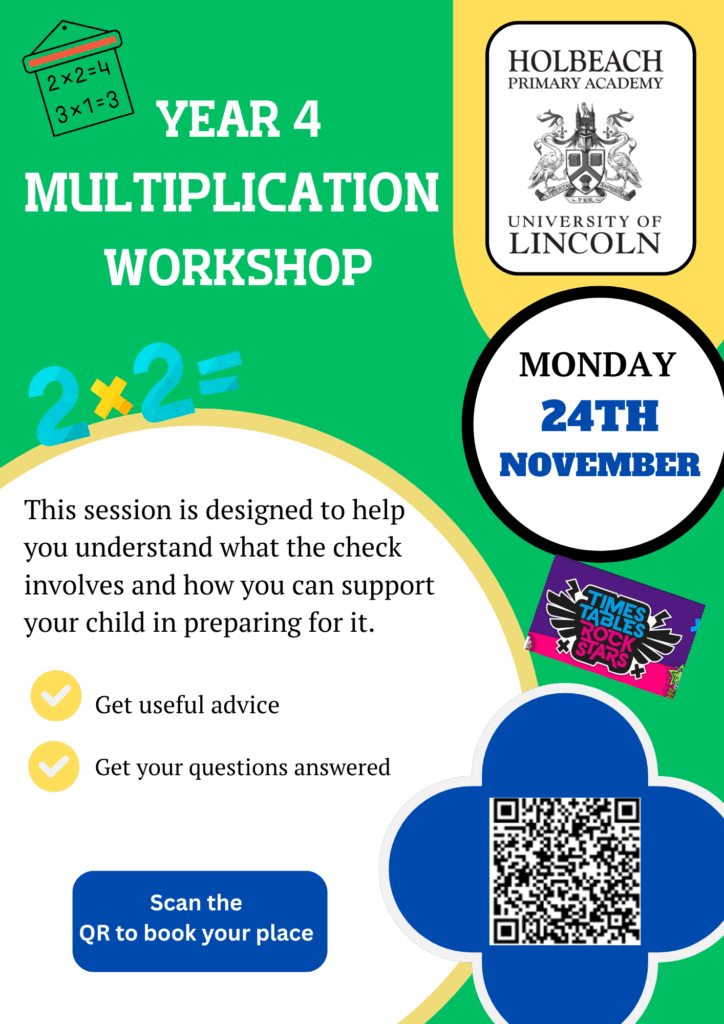
Year 4 Multiplication Tables Check 2025
In June 2021, the DfE set a national multiplication tables check for all Year 4 children to take.
Children will be prepared in classes through regular practise, both in paper form and electronically on iPads which is timetabled in throughout our Year 4 classes and as part of intervention to support knowledge.
Please see the leaflet below for further information released by the DfE for June 2025
TT Rockstars homework is assigned weekly, with pupils encouraged to access the platform at least three times per week at home. In Year 2, weekly TT Rockstars sessions focus on consolidating the 2, 5, and 10 times tables along with related division facts, preparing children for the transition into Year 3. Daily practice continues in Year 3, ensuring pupils can confidently recall and use the 3, 4, and 8 times tables, equipping them with the foundational knowledge required for Year 4.
Homework- consolidating mathematical knowledge
As an academy, we understand that re-visiting concepts, clarifiying methods and having opportunities to apply and practise what we have learnt is extremely beneficial.
Pupils are set regular homework tasks to compliment the teaching and learning that happens within their maths lessons. They are given opportunties to practise across a full range of units including number, geometry, measure and statistics.
Tasks can take many forms including, but not exclusive to:
- quizzes
- questions
- graphs
- interactive games
- calculations
- problems
- open ended investigations
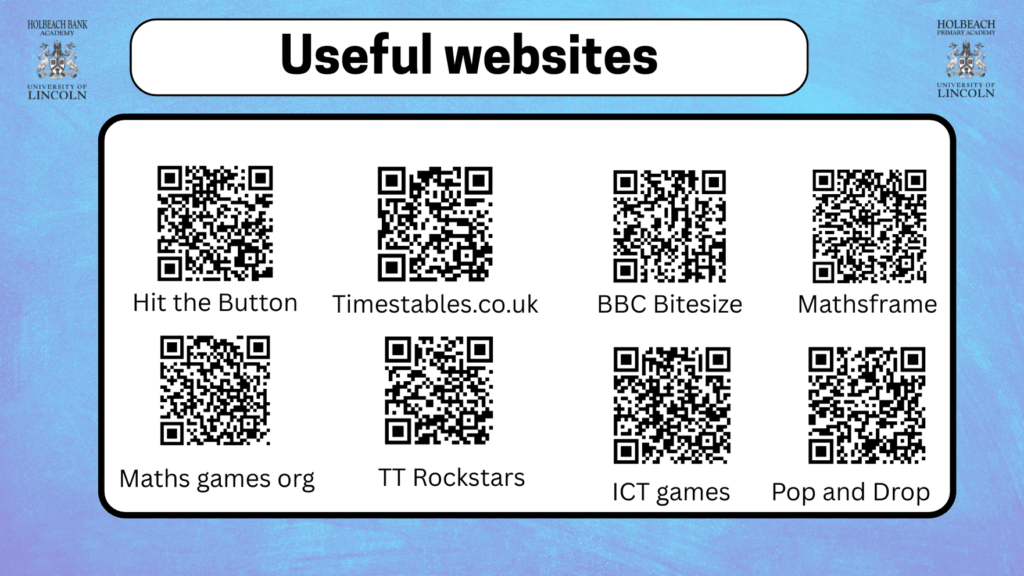
Homework is set weekly on Google Classroom where pupils can access weblinks, support videos, documents and forms set by their class teacher. Their outcomes are marked and returned with positive, diagnostic commentary.
NSPCC Number Day
We enjoyed a day of ‘Dress for Digits’ this year- our focus was how numbers are important in our daily lives. We solved puzzles and answered problems by applying Maths knowledge.]
We know that talk is important both in Maths and to keep one another safe- just like Buddy “Speak out Stay Safe
NSPCC Number Day- Friday 7th February 2025
What’s your favourite number? What numbers are special to your family? Could be house numbers, birthdays or lucky numbers! Where can you find numbers around your home or at the shops? What do these numbers mean?
Buddy from the NSPCC is running challenges on Friday 7th February at HPA to test your number knowledge! We would love for you all to take part. You could get involved by wearing non-uniform: the theme is ‘Dress Up for Digits‘.
For more information- see the letter attached below.
Check in here and on class webpages for photos of the day!
Don’t tie yourself in a knot!
We used knots at equal distances to solve problems in area and geometry.
Year 5 and 6
By creating several spaced knots, we could then be like builders through the ages (even the Egyptians!). We could use this method to draw circles, create arcs and right angles plus divide large areas equally such as a farmer dividing up his field for sowing crops.
NSPCC Rocks!
We joined forces in Year 3 and 4 to compete in the national game of NSPCC Rocks on Times Table Rockstars. We applied knowledge of facts, inverse and commutative laws and problem solving to act quickly in answering multiplication and division questions.
Year 3 and 4
Number knowledge!
We applied lots of place value and add/ subtract knowledge to succeed at multiple questions. Including:
– partition into tens and ones
-solve doubles with 2 digit numbers
-find inverse add/ subtract facts
Year 1 and 2
We discussed stratgies as a class. We also created our own Maths challenges to test a partner!